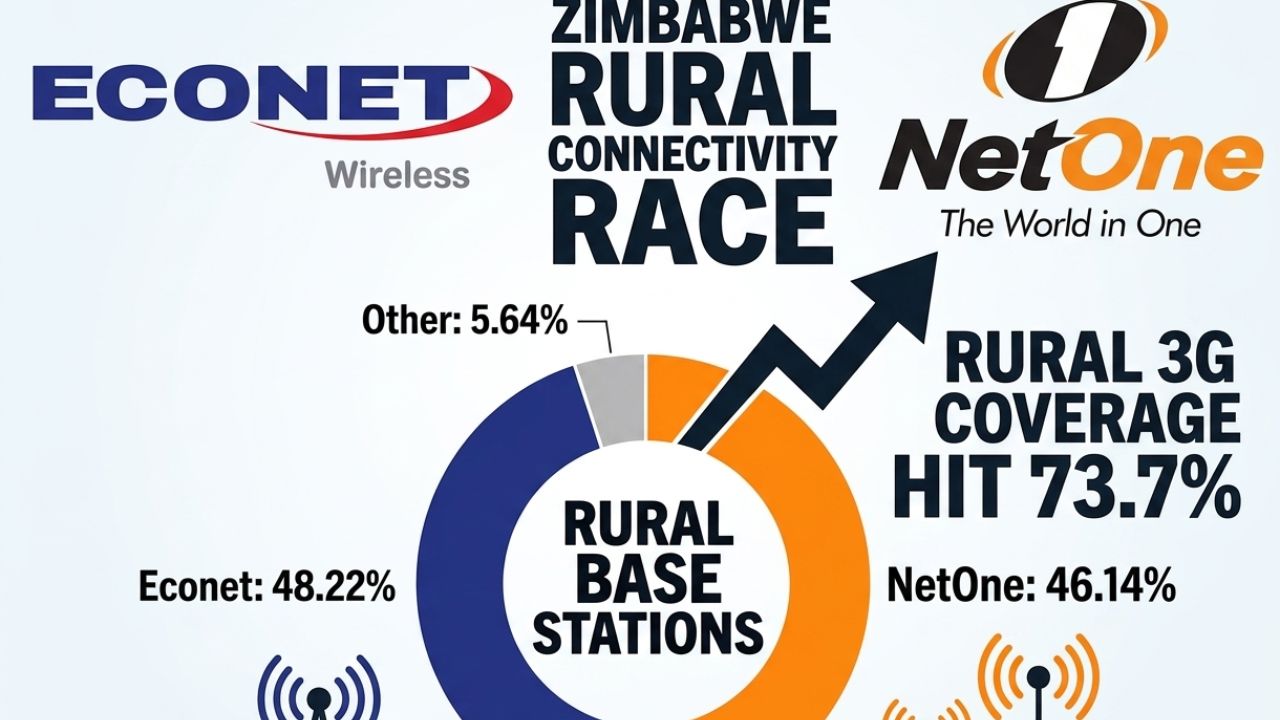
Zimbabwe’s rural landscape is undergoing a major digital shift as the country’s top mobile operators ramp up infrastructure spending. According to the latest sector report from POTRAZ for the final quarter of 2025, Econet Wireless and NetOne are driving a surge in connectivity that has brought 3G access to 73.7% of the rural population.
The data reveals a market where urban centers are no longer the sole priority. Econet currently maintains a slight lead, accounting for 48.22% of rural base stations, but NetOne is close on its heels with a 46.14% share. This leaves Telecel in a precarious position; the provider holds a mere 5.64% of the rural market and is showing clear signs of flatlining across its network categories.
Broadly speaking, basic connectivity is already well-established. 2G coverage now reaches 81.7% of the countryside, providing a stable foundation for voice calls and SMS. However, the real focus has shifted to high-speed data. While 5G remains an urban luxury for now—reaching about 18.9% of the national population—the rapid rollout of 167 new LTE and 98 new 3G sites in just three months suggests that rural areas are quickly moving toward modern data standards.
This expansion requires significant capital. Investment across the mobile sector jumped by 112% in the fourth quarter, totaling ZWG 1.08 billion. Such a massive spike in spending signals a clear commitment to moving Zimbabwe toward a data-heavy economy. As these networks expand, the digital divide is narrowing, making online services a reality for the majority of the population living outside major cities.