










Telecom
Telecel’s Last Stand? Embattled Telco Opens Tenders for New Investors Amid Corporate Rescue


The long-running soap opera that is Telecel Zimbabwe has reached its most critical plot point yet. After decades of shareholder infighting, mounting debt, and a steady slide into technological irrelevance, the company is officially hunting for a savior.

Telecel’s descent wasn’t overnight. Once a formidable challenger in the Zimbabwean mobile space, the company entered voluntary corporate rescue in November 2025 under the leadership of CEO Angie Vere. The move was a “break glass in case of emergency” maneuver intended to protect the firm from creditors while management attempted to restructure a balance sheet that was, quite frankly, underwater.
To understand how deep the hole is, one only needs to look back at the 2022 High Court filings by the Communication and Allied Service Workers Union (CASWUZ). At that time, Telecel’s liabilities were pegged at $24 billion against assets of just $1.5 billion . That $22.5 billion negative equity gap has only been exacerbated by declining revenues and a subscriber base that is jumping ship.
The “Telecel Tragedy” is rooted in its ownership history. What began as a promising consortium of local investors and international giant Telecel International devolved into years of litigation and boardroom brawls.
In 2015, the Amsterdam-based VimpelCom (now VEON) exited the mess, selling its 60% stake to the government parastatal ZARNet for $40 million. Today, that stake sits within the Mutapa Investment Fund, alongside state owned siblings NetOne and TelOne. This “unclear” acquisition by the state was supposed to stabilize the ship; instead, Telecel became the neglected middle child of Zimbabwe’s state-owned enterprises.
For a tech enthusiast, looking at Telecel’s current infrastructure is like looking at a museum exhibit. While competitors Econet and NetOne have spent the last few years in an arms race for 4G and 5G dominance, Telecel has been left in the dust.
With only 17 4G towers nationwide compared to the nearly 1,700 operated by Econet, Telecel isn’t just behind the curve it’s on a different planet.
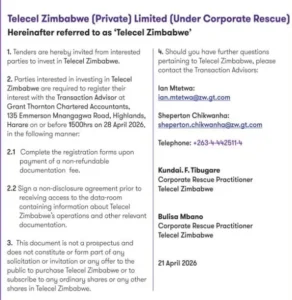
The practitioners, Kundai F. Tibugare and Bulisa Mbano, have clarified that this is not a public offer to buy shares but a search for a strategic partner or investor capable of injecting life-saving capital. Interested parties must get on touch with Transaction Advisors Ian Mtetwa or Sheperton Chikwanha at Grant Thornton.
Pay a non-refundable documentation fee.
Sign a Non-Disclosure Agreement (NDA) to access the “data room” where the full extent of the company’s financial health (or lack thereof) will be revealed.
Is Telecel still a viable investment? On one hand, you have a company with an existing (though crumbling) infrastructure, a license to operate, and a tiny but loyal subscriber base. On the other, you have a massive debt mountain and a technological deficit that will cost hundreds of millions of dollars to bridge.
Whoever steps up to the plate isn’t just buying a telco,they are buying a massive turnaround project. Whether this tender produces a white knight or simply marks the beginning of the final liquidation remains to be seen.
The deadline is April 28. We’ll be watching the Grant Thornton offices closely.
For more updates on the Telecel rescue and Zimbabwe’s tech landscape, stay tuned to Techunzipped.